Healthcare Learning Management System: What It Is and How to Choose One
A healthcare learning management system (LMS) is software that delivers, tracks and documents education for healthcare professionals, from mandatory staff training to accredited continuing education.
That definition covers two very different kinds of product. Pick the wrong kind and your team ends up filling the gaps with spreadsheets, manual certificates and a separate webinar tool.
The workload behind those gaps is large. Accredited providers delivered more than 242,000 educational activities in 2025 and logged 57.5 million learner interactions, according to the 2025 ACCME Data Report. Every one of those interactions needed attendance verified, credit calculated, a certificate issued and a record kept.
This guide explains what a healthcare LMS does, the two types on the market, the features that matter, and how to evaluate vendors. It ends with the questions to ask in a demo.
What is a healthcare learning management system?
A healthcare learning management system is the central platform where an organization hosts courses and live sessions, enrolls learners, verifies participation, awards credit and reports results.
A general corporate LMS does the first two jobs. A healthcare LMS is built around the rules that make medical education different: accreditation standards, license renewal cycles, credit types that vary by profession, and records that must hold up in an audit.
Five kinds of organization rely on one:
- Hospitals and health systems running onboarding, annual compliance training and CME programs.
- Medical associations and specialty societies delivering member education and earning revenue from it.
- CME and CE providers whose business is accredited education.
- Pharma, biotech and device companies educating clinicians on therapies and products.
- Mental health and allied health organizations serving psychologists, social workers, therapists and nurses.
Two types of LMS for healthcare: workforce training and continuing education
Most buying guides treat every healthcare LMS as the same product. There are two types, and they solve different problems.
| |
Workforce training LMS
|
Continuing education LMS
|
|
Main job
|
Keep employees compliant and competent
|
Deliver accredited education and award credit
|
|
Typical learners
|
Your own staff
|
Members, customers and clinicians inside or outside your organization
|
|
Typical content
|
HIPAA, OSHA, infection control, onboarding, annual competencies
|
CME courses, grand rounds, webinars, conferences
|
|
What gets tracked
|
Assignments completed, by role and due date
|
Attendance, engagement and credits earned, by type and accrediting body
|
|
What it produces
|
Completion reports for surveyors
|
Certificates and credit records for accreditors and licensing boards
|
|
Money
|
A cost to manage
|
Often a revenue line: registrations, memberships, sponsorships
|
|
Usual buyer
|
HR, learning and development, compliance
|
CME director, education director, association executive
|
Platforms such as HealthStream, Relias and MedTrainer are best known for the first type. BeaconLive is built for the second.
Many organizations need both. A hospital may run a workforce LMS for annual compliance and a continuing education platform for its CME program and grand rounds.
If your work sits in the right-hand column, schedule a BeaconLive demo and see how it would handle your program.
Why a generic LMS falls short in healthcare
A corporate LMS answers one question: did this person finish the course? Healthcare education has to answer harder ones.
- Credit is not completion. You need to know how long a learner attended, whether they stayed engaged, and how many credits of which type they earned.
- Requirements change by profession and state. A physician, a nurse and a pharmacist can sit in the same session and each need different credit and different certificate wording.
- Accreditors expect evidence. Accredited providers must keep activity and learner records and produce them at reaccreditation or audit.
- Live education still matters. Grand rounds, webinars and conferences sit at the center of most programs. Many LMS platforms only handle self-paced courses, which forces a second tool and manual attendance matching.
- Learners are often outside your organization. They need to find a course, register, pay and get in without calling your office.
When a platform cannot do these things, staff do them by hand. That is where the hours go.
Must-have features of a healthcare learning management system
Nine capabilities separate a healthcare LMS from a course library with a login page. Use them as your requirements list.
1. Accreditation and credit management
The system should award several credit types from a single activity and apply each accrediting body's rules. Check that it covers every profession you serve.
|
Learner
|
Common credit
|
Accrediting body
|
|
Physicians
|
AMA PRA Category 1 Credit
|
ACCME and state medical societies
|
|
Family physicians
|
AAFP Prescribed credit
|
AAFP
|
|
Nurses
|
Contact hours
|
ANCC
|
|
Pharmacists
|
CPE credit
|
ACPE
|
|
Physician assistants
|
AAPA Category 1 CME credit
|
AAPA
|
|
Psychologists
|
CE credit
|
APA
|
|
Interprofessional teams
|
IPCE credit
|
Joint Accreditation
|
If your audience includes nurses, confirm that a nursing LMS workflow is included and not a paid add-on. For background on credit types, see BeaconLive's guides to CME credits and CME vs. CEU.
2. Attendance and engagement verification
Look for presence checks, minimum-duration rules, polls and quizzes on both live and on-demand content. These turn "registered" into "verified."
3. Automated certificates
Certificates should issue the moment a learner meets the requirements, with the wording each accreditor requires. Learners should get them by email and find them later in a personal dashboard.
4. Live and on-demand delivery in one place
Webinars, virtual and hybrid conferences, and recorded courses should share one catalog and one learner record. Otherwise you reconcile attendance across tools after every event.
5. CME tracking and learner transcripts
Learners should see credits earned and credits still required. Administrators should see who is on track and who is behind. Good CME tracking software also handles carryover credits, caps and multiple memberships.
6. Reporting and audit trails
You need real-time dashboards, custom reports and a time-stamped log of every change. The test is simple: can you answer an accreditor's request in minutes?
7. Registration and eCommerce
If education brings in revenue, the platform should sell single courses, bundles and subscriptions without a separate storefront.
8. Integrations and open APIs
The LMS should exchange registration, completion and certificate data with your association management system, CRM or HR system. Ask whether it can also issue certificates for events you host on another webinar tool.
9. Branding, access and support
Learners should see your brand, not the vendor's. The platform should run in a browser on any device, offer captioning, and come with support for learners as well as administrators.
How to choose a healthcare LMS in six steps
- Decide which type you need. Workforce training, continuing education, or both. This one decision removes half the vendors from your list.
- List every credit type and accreditor. Include each profession and each state or board you report to.
- Map your delivery formats. Count live webinars, in-person and hybrid conferences, and on-demand courses for the year ahead.
- Inventory the systems it must connect to. Membership database, CRM, HR system, payment processor and any webinar tool you plan to keep.
- Measure today's admin time. Record the hours spent per activity on attendance, certificates and reporting. That number is your baseline for return on investment.
- Shortlist three vendors and run the same scenario with each. Use one real activity from your calendar so the comparison is fair.
Questions to ask in a healthcare LMS demo
A demo should show your workflow, not a slide deck. Bring these eight questions.
- Can you show one live session awarding two different credit types?
- How do you verify attendance on live and on-demand content?
- What does the learner see when the session ends, and how fast does the certificate arrive?
- Can you build the report I would hand an accreditor?
- Can we keep our current webinar tool and still automate certificates?
- Who supports us during a live event, and can learners reach support directly?
- What does implementation involve, and who on your team does the setup?
- How is pricing structured: by learner, by event or by annual license?
Three mistakes to avoid
- Buying on course-library size when your organization creates its own content.
- Treating live events as an add-on. If half your credits come from live sessions, live delivery is the core requirement.
- Forgetting the learner. A clinician who cannot log in between patients will not come back.
Comparing specific vendors? Read BeaconLive's review of the 7 best healthcare CME LMS platforms.
How BeaconLive works as a healthcare LMS for continuing education
BeaconLive is a continuing education LMS and events platform that healthcare, biotech, and pharma organizations use to deliver CME. It covers the full cycle, from registration to certificate, in one branded system.
- Accreditation support. The platform supports ACCME and AMA requirements. BeaconLive's CE specialists configure jurisdiction rules, credit dashboards and certificate delivery for you.
- A white-labeled CME catalog. Live and recorded courses sit in one catalog with course details, speaker bios and credit information.
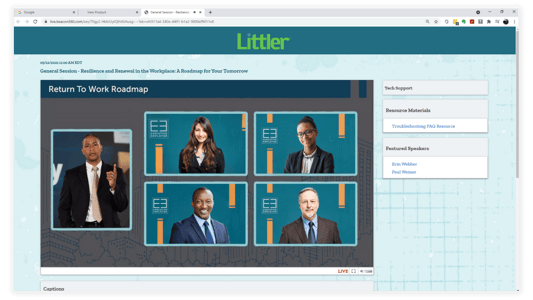
- Built-in webinars and events. Run webinars, virtual conferences and hybrid events with presence checks, polls and quizzes that confirm engagement.
- Automated certificates. Certificates carry your branding and the elements your accrediting body requires. They arrive by email and stay in the learner's dashboard.
- Compliance tracking. The Beacon360 Compliance Tracker follows credits against the rules of more than 70 professional associations, including carryovers and caps, with a full audit trail.
- Integrated eCommerce. Sell courses, bundles and subscriptions with secure payment processing.
- APIs and outside events. APIs and webhooks move registration and certificate data to your other systems. BeaconLive can also issue certificates for sessions hosted on Zoom, Webex or Teams.
- People, not just software. Every client gets event producers, moderators and 24/7 technical support for staff and learners.
The Tennessee Medical Association's director has credited the BeaconLive team with helping her launch the association's first CE product and carry its brand through the interface.
Want to see it with your own credit types and formats? Schedule a demo with a BeaconLive specialist.
See a healthcare learning management system built for continuing education
The right healthcare learning management system takes attendance, credit and certificates off your team's plate, so the hours go back into the education itself.
If you deliver CME or other accredited education, bring one real activity to a demo. A BeaconLive specialist will show how it would run, from registration page to certificate.
Schedule your BeaconLive demo or call Platform Sales at 866.638.2907.